The Problem
Application tracking systems (ATS) must offer flexibility while offering a consistent experience that enables Hiring Managers and Recruiters to filter applicants effectively and efficiently.
In the recent past, I have interacted with many application tracking systems (ATS). This affords me the opportunity to stretch my Product Manager and UX design skills to improve the process. While each system and company offers different products and services, my approach is as if the feedback were for a single system.
The Data
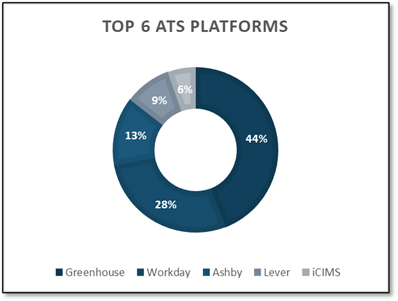
A review of companies where I perform posting checks weekly. The list is categorized by industry and ATS. The full population is 703 companies. The top 5 ATS represent 494 companies or 70% of companies reviewed.
The SWOT analysis
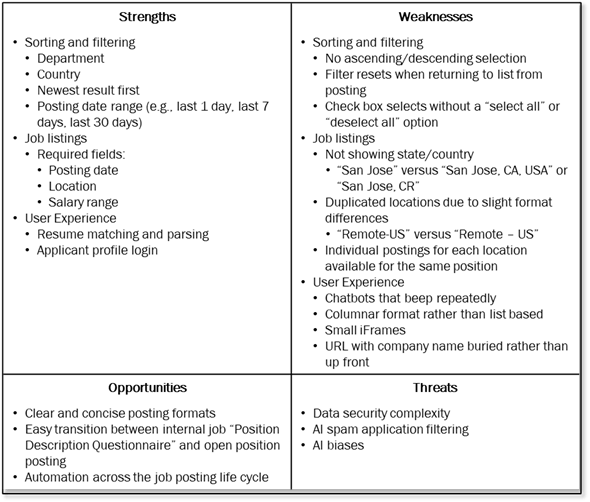
A “strengths, weaknesses, opportunities, threats” (SWOT) analysis was performed. It reveals features that users find important and ones that lead to frustration. These user frustrations may restrict the user’s ability to find relevant positions and may discourage future interactions. (Please note that I am the only user this feedback reflects, a full VOC and UX research process should be conducted to confirm findings.)
Recommendations
There is at least one quick hit that could likely be completed quickly. Namely creating validation within posting locations to prevent duplicates. This would enhance not only the applicant experience; it would improve the data retained in the ATS by reducing the amount of data massaging needed.
A few short to mid-term enhancements that I would prioritize to improve the experience include: adding ascending / descending ability for filters, adding the “select all” / ”deselect all” options within drop downs with checkboxes, adding state and country indicators in postings and filters. The first two serve to improve the applicant search process by reducing clicks needed to accomplish their goals. The last is likely to improve the Hiring Manager and Recruiter efficiency by reducing the number of applications received outside of the applicant’s country that must be filtered out.
Leveraging the strengths can help address the opportunities by creating a validation loop that enables Hiring Managers and Recruiters to easily create new postings that leverage existing PDQ formats.
Ongoing monitoring of the threat landscape needs to be performed to ensure the system continues to operate securely. A breach, especially with this level of personal information, could quickly erode user and company confidence in the ATS. It would likely result in large financial exposure due to any credit monitoring and loss of company relationships.
Reducing any AI biases is an ethical mandate that any ATS Product Manager must regularly evaluate. Reviews of historical populations, creating predictive modeling and comparing to current populations is an important step in identifying any biases that may have cropped up.
 My Life in Practice
Leave a comment